
Search Greensboro Voter Registration
Begin with the free NCSBE Voter Search. Enter the registered first and last names, then choose Guilford County when a common name produces several matches. A middle initial and year of birth can narrow the result. The status controls are also part of the query. At least one of Registered, Removed, or Denied must be checked. Searching more than one status can explain why an expected active profile does not appear.
| Lookup label | Control | Required | How to use it |
|---|---|---|---|
| First Name | Text | Yes | Enter the voter's first name |
| Middle Initial | Text | No | Use one initial to narrow similar names |
| Last Name | Text | Yes | Enter the voter's last name |
| Year of Birth | Dropdown | No | Select a year, not a full birth date |
| County | Dropdown | No | Choose Guilford for a Greensboro search |
| Voter Status | Checkboxes | Yes | Select Registered, Removed, Denied, or more than one |
| Search / Clear | Buttons | Not applicable | Run the query or reset all fields |
The lookup is a person-by-person search, not a way to browse the whole Greensboro voter roll. Review the official voter-search screen before entering a name.
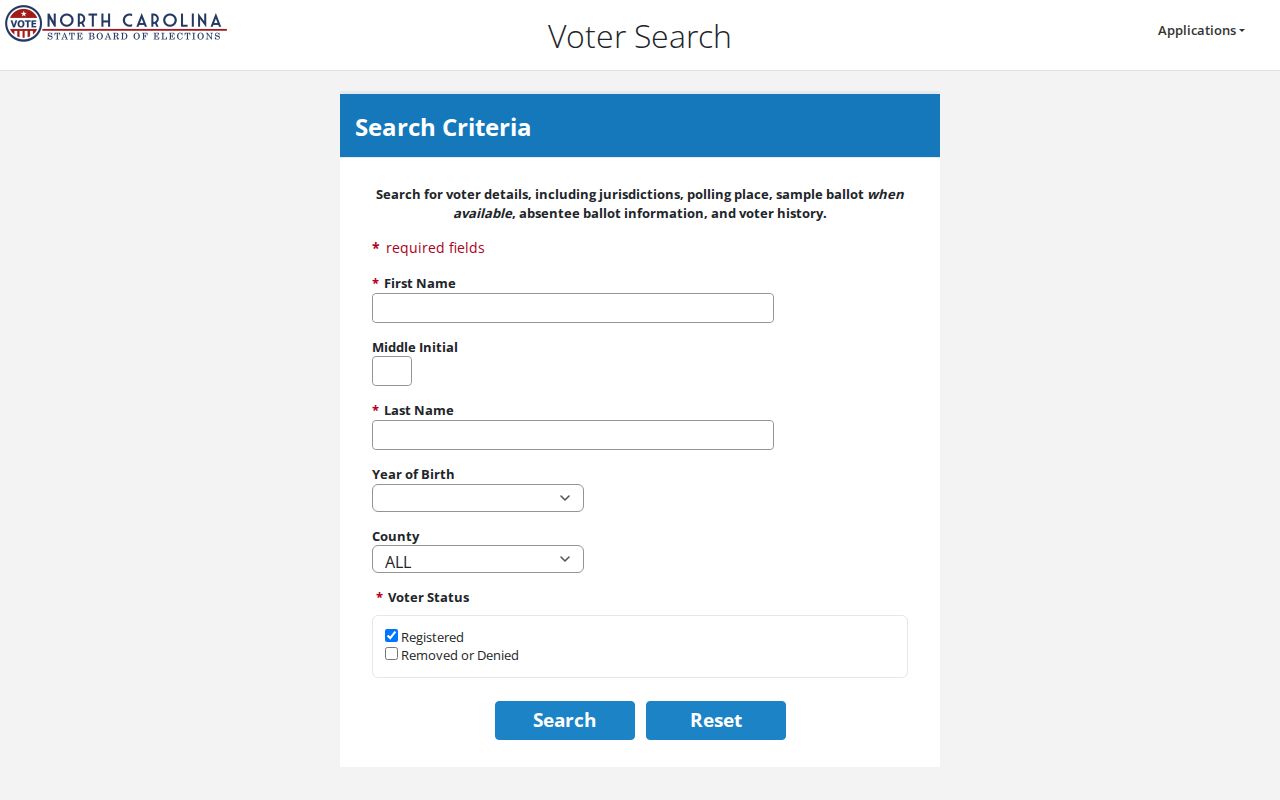
The captured form shows why both the county and status filters matter. If the web search still fails, ask the Guilford County Board of Elections to identify the right registration record or status category rather than guessing from a name alone.
Read a Greensboro Voter Record
A match opens an organized voter profile. Its six groups separate core identity and status data from districts, voting sites, sample ballots, mail or early-voting details, and participation history. That structure matters. A precinct is an election assignment, while a municipality or ward is a local district assignment. Neither field proves that every address using a Greensboro postal label lies inside city limits.
| Voter details | Registered name, county, status, county registration number, statewide NCID, party, race, ethnicity, gender, recent registration date, and NCDMV-customer indicator |
|---|---|
| Public address | Residence information when it is not suppressed for a protected voter |
| Jurisdictions | Precinct, congressional and state legislative districts, courts, prosecution, county commissioner, municipality, ward, and school district where applicable |
| Voting locations | Upcoming Election Day site, site-address link, sample ballot, and board contacts |
| Absentee or early voting | Election, county, ballot status or type, return date, method, and status when applicable |
| Voter history | Election, voting method, county, and primary ballot category |
| Registration status | Registered, inactive, removed, or another official status shown by the system |
A statewide NCID is the election system's identifier, not a driver's license number. Use the county registration number or NCID when asking the board to distinguish two people with similar names. Public demographic codes should also be read as file fields, not as proof of a person's current identity or circumstances.
Note: A registration profile is an election record, not proof that the listed residence or district assignment has never changed.
Private Fields in Greensboro Voter Records
North Carolina draws a specific line between public election data and confidential identifiers. Under G.S. 163-82.10, a full or partial Social Security number, date of birth, driver-license number, voter-photo-ID image, identification photocopy, election-law email, and the public agency through which a person registered are withheld from Chapter 132 disclosure. A signature may be viewed, but it may not be copied or traced.
Confidential by statute. North Carolina releases age but restricts date-of-birth disclosure under G.S. 163-82.10B. Protected residence addresses are also suppressed when the voter meets the statutory safety process.
The year-of-birth option on the public search does not turn the full date of birth into a public field. Likewise, an identification-validation issue does not make the underlying driver-license number or Social Security digits public. The public profile and downloadable files must be read within these limits.
Greensboro Voter History, Not Choices
Voter history can show that a person participated in an election, the method used, the county, and a primary ballot category. It never shows the candidates or ballot options selected. This is a vital limit because participation data is easy to overread. The secret ballot remains secret whether the history row says Election Day, early voting, absentee, or another recorded method.
A profile may also link to an eligible sample ballot for an upcoming contest. That sample reflects the voter's assigned ballot style and districts. It is not a marked ballot and says nothing about intent. Use the history only to confirm recorded participation or to distinguish people with otherwise similar names.
Myth: voter history reveals a vote. Greensboro voter records show participation and method, never candidate selection. Do not infer political choices from a history row.
Download North Carolina Voter Files
The NCSBE voter-registration data page publishes statewide and county registration extracts as well as voter-history files. The county download isolates Guilford records, while the statewide extract supports comparisons or a search that extends beyond Greensboro. Standard registration fields include county, voter-registration number, name parts and suffix, status, party, residential and mailing geography, precinct, municipality, district assignments, registration date, and demographic codes permitted for release.
The official download and request options distinguish ready-made data from custom requests.
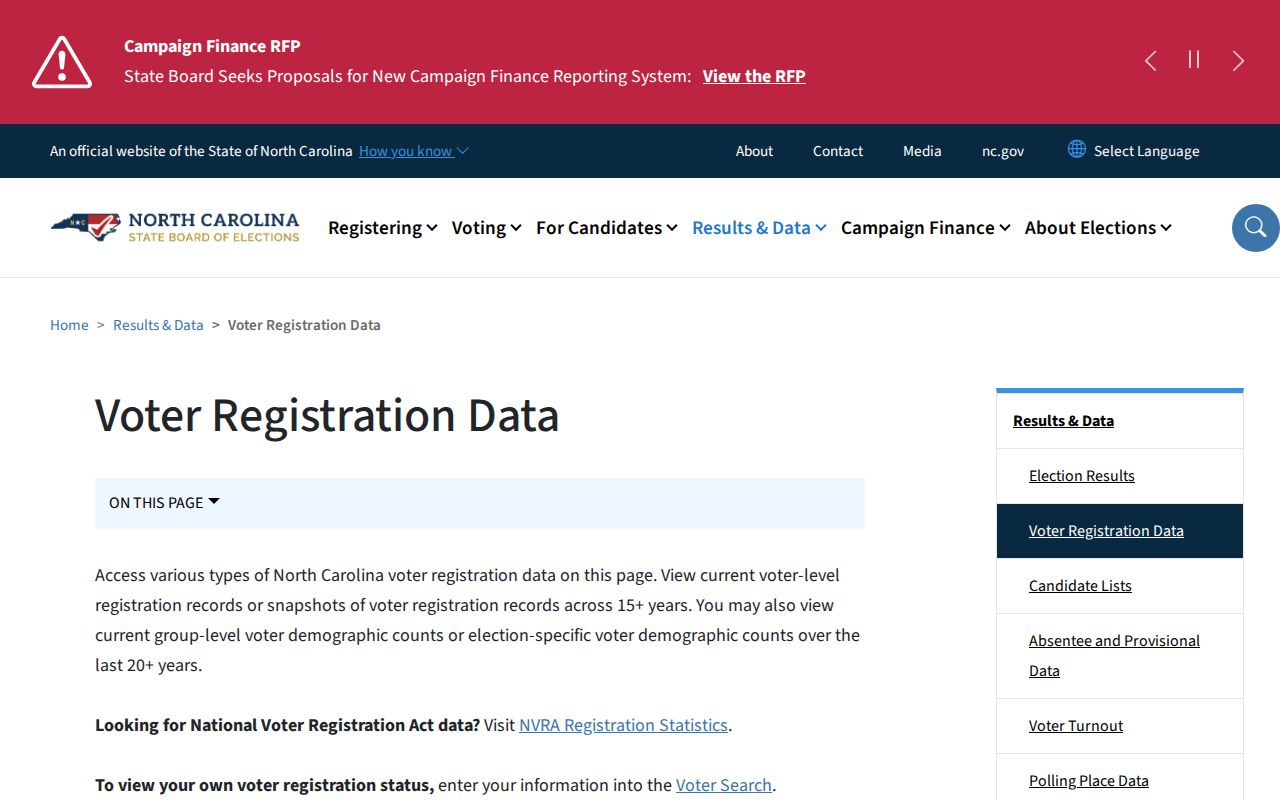
The data screen is the most direct route when the standard extract already contains the needed public fields. A custom compilation may not be needed.
- Choose the statewide or Guilford County registration extract, or select the separate voter-history file based on the question being researched.
- Read the file layout and retain identifiers such as county registration number and NCID so similar Greensboro names do not get merged.
- For a tailored list, define the county or precinct, date range, public fields, format, and election before contacting NCSBE or the county board.
- Keep confidential fields protected and follow the statutory limits on commercial use, stalking, and harassment.
History extracts identify the election name or date, voting method, county, and precinct. They contain no candidate choice. North Carolina permits a county board, upon request, to provide any person a countywide or precinct list. A selective list can use public categories such as party, gender, race, registration date, precinct, districts, and voter-history categories. Age may serve as a selection, but date of birth may not be disclosed.
Request Greensboro Voter Records Locally
The Guilford County Board of Elections is the local custodian for registration applications, precinct assignments, local notices, absentee records, and election-administration files. Ask for a named record set, election, date range, public fields, and preferred format. Staff can locate election records, but a broad request to research a person's life is not a defined record request.
Greensboro elections office
301 W. Market St.
Greensboro, NC 27401
336-641-3836
Weekdays, 8 a.m. to 5 p.m.
Mail and email
PO Box 3427
Greensboro, NC 27402
guilfordelections@guilfordcountync.gov
Fax: 336-641-7676
High Point branch
325 E. Russell Ave.
High Point, North Carolina
A second county channel for Guilford election services
The official local election-services page should be checked before a visit.
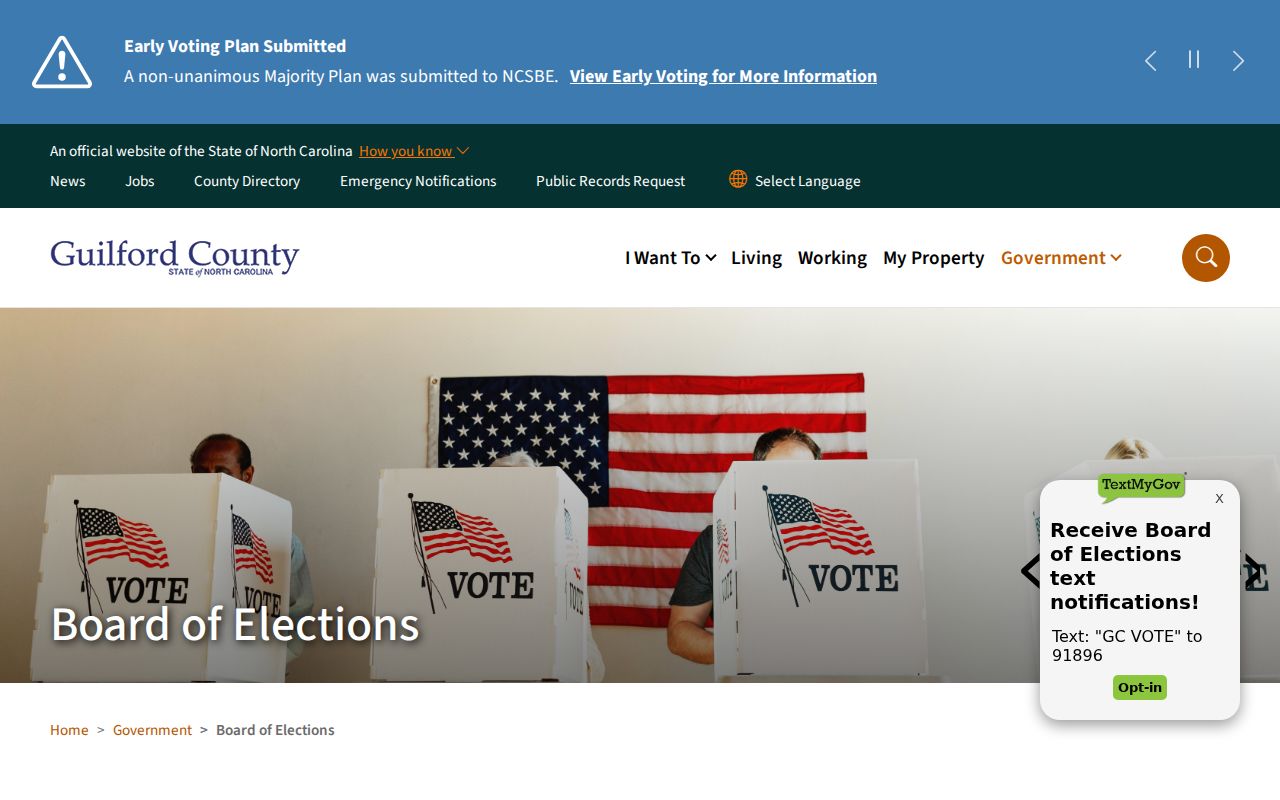
The county page gives the current contact route and voter services in one place. Confirm posted hours and service details there because public office information can change.
Note: Greensboro is a Guilford County seat, but voter-record custody rests with the county board and statewide election system.
Greensboro Voter Roll Status Changes
An inactive label is an administrative status, not a finding that a voter left the listed address. It may follow undeliverable mail and an address-confirmation process. Federal safeguards generally prevent cancellation solely for failure to vote. The process uses confirmation and a required waiting or federal-election cycle before removal. Other paths include death, a felony sentence, duplicate registration, a confirmed move, or the voter's own request.
A May 2025 NCSBE explanation reported 498,889 statewide removals from January through March 2025. Of those, 419,937 followed inactive status and two federal elections. Other statewide categories included 25,119 deceased voters, 40,357 in-state move duplicates, 7,017 other duplicates or merged records, 2,849 felony sentences, 2,784 out-of-state moves, 514 voter requests, and five confirmed noncitizens. Those are North Carolina totals, not Greensboro counts.
A February 2026 NCSBE notice also discussed letters sent to more than 241,000 voters whose identification data did not validate against government databases. Spelling, punctuation, prior names, transposed characters, and entry differences were among the possible causes. A letter did not by itself mean each recipient was ineligible. Check the live voter record and board response rather than treating the notice as a final status.
Protected Greensboro Voter Addresses
North Carolina's Address Confidentiality Program provides a substitute address and mail forwarding for qualifying survivors of domestic violence, sexual assault, stalking, or human trafficking. For voter-record protection, the county receives a qualifying order or a current program card plus a signed safety statement. The actual residence is then kept out of public voter records.
Protection does not erase the whole registration. The person's name, precinct, and other registration data remain public while the residence is suppressed. A missing address should therefore be treated as an intentional safety measure, not a defective search result. Never try to reconstruct it from district lines, mailing data, or another public file.
Trace Historical Greensboro Voter Rolls
Modern NCSBE search results do not replace older election records. Historical registration books, poll books, and election returns may survive in Guilford County series or at the State Archives of North Carolina. Ask by election year, precinct or township, and record type. These books can place a person in a community even when no current web profile exists.
County history affects the search. Guilford County began administration in 1771, before Greensboro was established as the planned county seat. Earlier families may appear in Rowan or Orange records, while later changes sent territory to Randolph and Rockingham. Archives organize county material by record group, series, and date, so a catalog search for a person's name alone can miss a poll book or election return that has not been indexed by voter.
The research trail may continue through Greensboro Public Library genealogy resources, city directories, newspapers, and census schedules. Those sources can help identify the right person, precinct, or era before an archival request. They do not convert an old election list into proof of a modern address.
Use Greensboro Voter Data Lawfully
G.S. 163-82.10 restricts commercial use of voter-registration data except for election, political, governmental, journalistic, and statistical uses defined by law. Public access does not cancel anti-harassment rules. North Carolina stalking and harassment laws, including G.S. 14-277.3A and Chapter 50C remedies, can apply when records are used to threaten, monitor, or repeatedly harass someone.
Keep the inquiry tied to a lawful civic, historical, statistical, or personal purpose. Confirm a current profile with the official lookup, preserve protected fields, and contact NCSBE or the Guilford board if a file appears to expose restricted data. General access rules for other custodians belong with Greensboro public records; election data follows its more specific statutes.
Voter records change as registrations, addresses, and district assignments change. Record the extract date and verify time-sensitive facts with the custodian before relying on them.